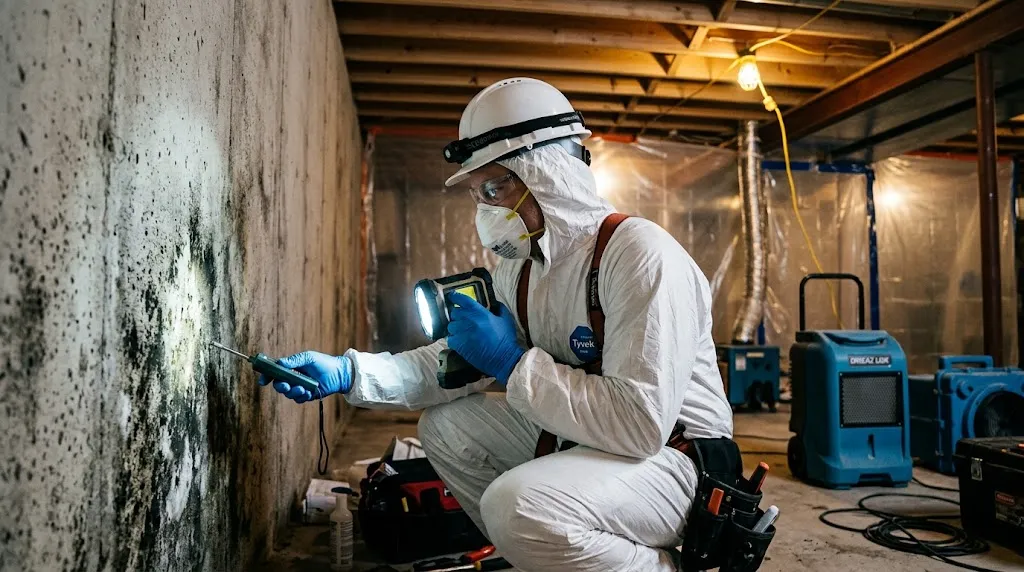
To get rid of mold in a basement, you must fix the water leak, seal off the work area, throw away porous items, and scrub hard concrete with white vinegar or an EPA-registered cleaner. Run a heavy-duty dehumidifier right away to bring the relative humidity below 50 percent so remaining spores cannot grow back. Never use standard bleach on bare concrete or structural wood framing because it feeds the deep fungal roots. Following these exact steps removes active colonies safely and keeps your foundation dry for years to come.
If you own a home with an underground room, this guide will help you protect your foundation, stop dangerous fungal growth, and breathe clean air indoors. Discovering fuzzy dark spots near the floor joists or smelling a sharp, earthy odor can make anyone nervous. Learning how to get rid of mold in basement spaces gives you the power to protect your building materials and safeguard your family’s health before structural rot sets in.
Eliminating Basement Mold for Good: The Proven Field Guide
You walk down your basement stairs, turn on the overhead bulb, and immediately pick up that heavy, pungent, mushroom-like smell. That sharp odor comes from microbial volatile organic compounds, which are real chemical gases that active mold colonies release while digesting damp wood, paper, and dust. Over ten years of hands-on remediation across residential properties, our crew at MoldOut California has seen every kind of basement dampness imaginable. Homeowners usually uncover these hidden colonies by accident while dragging out holiday boxes, shifting old rugs, or replacing a rusted water heater. The first reaction is almost always to grab a spray bottle of kitchen cleaner and scrub down the surface. That quick fix clears the visible discoloration for a weekend, but it leaves the living root structures completely intact inside the pores of your foundation.
A basement functions unlike any other room inside your house. It sits surrounded by cool, wet earth that presses against masonry walls day and night throughout the year. Treating an underground space requires an organized system rather than a quick wipe-down. You must view the entire room as a connected mechanical box where soil moisture, air currents, temperature changes, and framing timbers constantly interact. When you wash a spot on the concrete without cutting off the incoming dampness, the fungus will sprout back across the exact same wall within two or three weeks. Achieving a permanent fix demands that you track down the plumbing or groundwater leak, seal off the doorways so tiny airborne particles do not drift upstairs, throw out ruined belongings, scrub hard surfaces with the right cleaning agents, and dry out the air. Following each step in the correct order saves your framing and keeps your family from breathing in airborne contaminants.
Why Basement Fungus Thrives (and Why It Affects Your Entire Home)
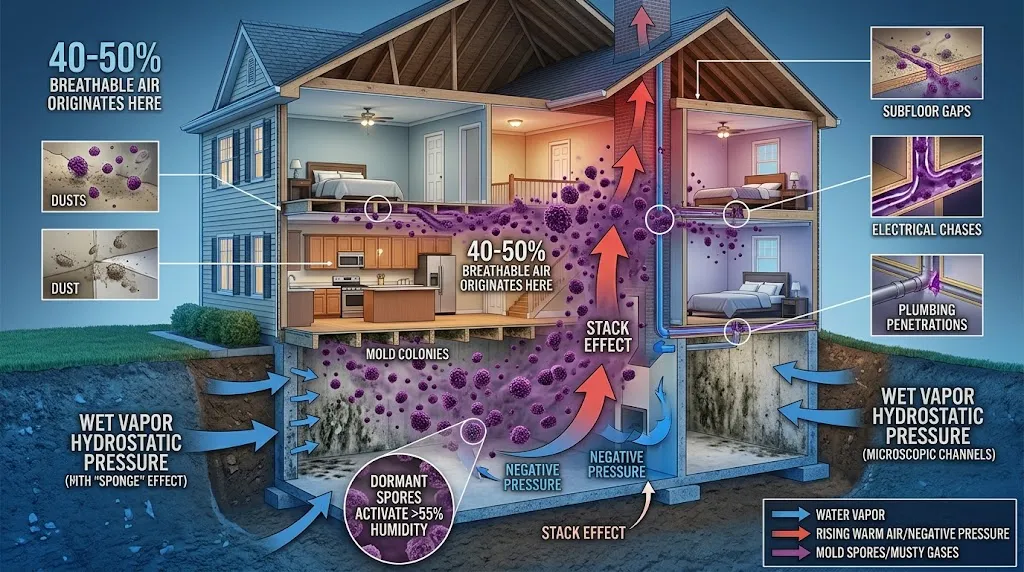
Basements stay naturally cool and damp because they rest below the outdoor ground level. The surrounding soil collects rainfall, lawn irrigation, and natural groundwater. This standing moisture exerts steady hydrostatic pressure against exterior foundation walls. Poured concrete and concrete masonry blocks look solid, but under a microscope, they act like dense sponges filled with millions of microscopic channels. Liquid moisture and vapor wick straight through these tiny capillaries from the wet outside dirt into the dry basement air. Once this water vapor reaches the cool indoor space, the relative humidity shoots upward. When indoor humidity crosses 55 to 60 percent, dormant spores activate, settle onto organic dust, and begin multiplying across floor joists and drywall within 24 to 48 hours.
Many families assume that keeping the heavy basement door latched traps the bad air downstairs. Building science reveals the opposite truth through a natural physical airflow pattern known as the stack effect. Warm air inside your kitchen, living room, and upstairs bedrooms naturally rises toward the roof, slipping out through ceiling vents, recessed can lights, and attic gaps. As this warm air escapes upward, it creates negative pressure at the lowest level of the house. This suction draws air up from the basement through subfloor gaps, electrical wire chases, and plumbing penetrations. In an average two-story house, 40 to 50 percent of the air you breathe on the ground floor originates directly in the basement. When active colonies thrive below, this chimney effect pulls microscopic spores and musty gases directly into the rooms where your family sleeps and eats every day.
White Mold or Harmless Efflorescence: How to Tell the Difference
Homeowners frequently spot a bright white, powdery coating spreading across their gray concrete walls and assume the worst. During our field inspections, we find that roughly half of these white patches are actually efflorescence instead of living fungal growth. Efflorescence happens when groundwater wicks through the porous foundation wall and evaporates into the basement air. As that water turns into vapor, it leaves behind dissolved mineral salts from the soil and concrete mix. These salts dry out into a chalky, crystalline crust across the bare masonry. While efflorescence proves that moisture is pushing through your wall, it contains no organic matter, produces no spores, and causes no respiratory harm.
You can perform a quick water-drop test on your wall using a sample of the white powder. Scrape a small pinch of the white residue into your palm, add three drops of water, and rub your fingertips together. If the powder dissolves instantly and turns into a clear liquid, you are touching harmless mineral salts. Fungal hyphae from common white molds like Penicillium or Aspergillus will never dissolve in water. The mold strands will stay intact, feel slippery or gritty, and float on top of the water droplet. Living white mold also grows in soft, thread-like circles that spread across both wood beams and concrete, whereas efflorescence only forms on masonry surfaces like stone, mortar, and concrete. You can sweep salt deposits away with a dry nylon brush, while living mold clings tightly to wall pores and emits a distinct, earthy odor.
The 10-Square-Foot Rule: When to DIY vs. When to Call a Certified Crew
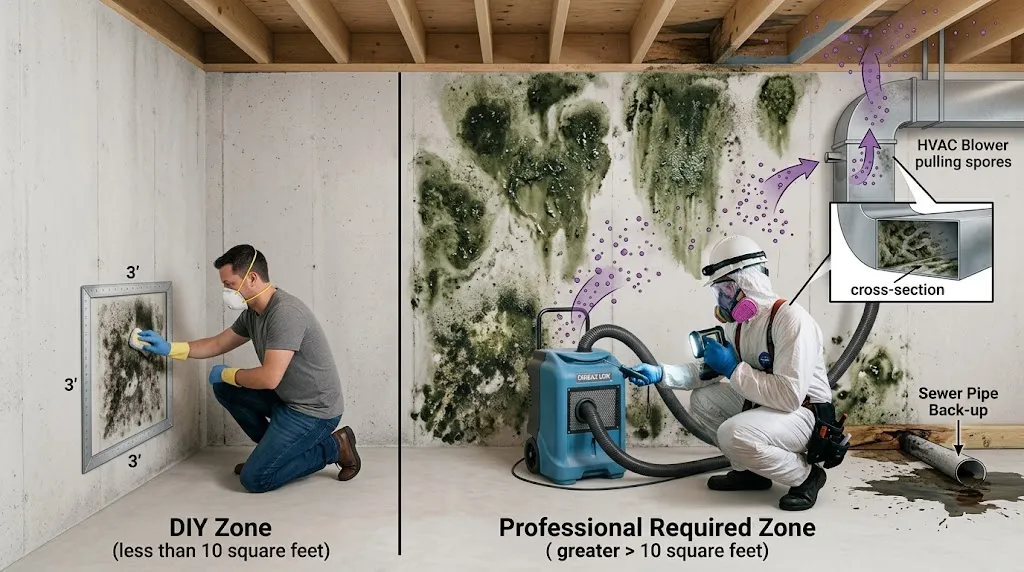
Before grabbing any cleaning supplies, you need to measure the total surface area covered by the growth. The standard rule established by the Environmental Protection Agency sets ten square feet as the clear boundary line for safe homeowner cleanup. Ten square feet equals a three-foot by three-foot square patch, which is roughly the size of a standard household interior door. If your mold patches add up to less than this footprint, you can safely tackle the cleanup yourself using basic safety equipment, common household cleaners, and careful containment practices. Minor surface patches on a concrete corner or a small spot on a wooden shelf fall safely within this DIY boundary.
When contamination spreads beyond ten square feet, the job requires specialized equipment. Large colonies release millions of microscopic spores into the air the moment you touch them with a brush. Attempting to scrub large areas without professional air scrubbers will contaminate the rest of your house. You must also call a certified contractor if you spot thick, slimy, greenish-black patches identified as Stachybotrys chartarum, or if the growth touches your furnace and air ductwork. If an HVAC blower pulls air past open fungal colonies, it pushes spores into every room upstairs within minutes. Contamination caused by backed-up sewer pipes, standing floodwater, or rotten structural sill plates also demands professional containment under the IICRC S520 standard to protect structural integrity and indoor air quality.
Setting Up Your Work Zone: Essential Safety Gear and Negative Air Containment
Proper preparation keeps tiny spores from spreading throughout your home while you clean the basement. Setting up safety barriers and managing airflow protects your lungs and prevents cross-contamination in upper-level living areas.
- Put on a tight-fitting N95 respirator or half-face P100 mask, unvented safety goggles, and thick nitrile gloves to shield your lungs, eyes, and skin from flying spores.
- Shut down your central heating and air conditioning system at the main thermostat so the furnace fan does not pull basement air into the ductwork.
- Cover all HVAC supply vents, return grilles, and pipe gaps in the basement with heavy six-mil plastic sheeting and blue painter’s tape.
- Place a standard box fan inside an open basement window, facing the blades outward so the fan exhausts indoor air directly outdoors.
- Seal the open window gaps around the box fan using cardboard and tape to create negative air pressure inside the room.
- Crack open a small window on the opposite side of the basement to bring in fresh outdoor air without letting dusty basement air leak upstairs.
- Hang a temporary plastic barrier with a zippered doorway over the basement stairs to isolate your work area completely from the main house.
Why Household Bleach Fails on Concrete and Wood
Walking down the cleaning aisle at the local hardware store might lead you to believe that chlorine bleach solves every mold problem. Using common household bleach on concrete walls, mortar joints, and wooden floor joists is one of the most counterproductive mistakes a homeowner can make. Store-bought bleach contains roughly ninety percent water and only a tiny fraction of sodium hypochlorite. Concrete and structural timber are highly porous building materials filled with microscopic channels. Because liquid bleach has high surface tension, the active chlorine molecules remain trapped on the outer surface. The chlorine cannot penetrate the deep pores where the root-like hyphae anchor themselves.
The water component in the bleach bottle behaves very differently. While the chlorine chemical evaporates rapidly into the air, the water soaks straight into the concrete pores and wood grain. You might see the dark surface stains lighten up for a few days, but deep inside the pores, you just fed the surviving fungal roots a massive drink of water. Within two to three weeks, the colony returns thicker and stronger than before. Bleach also releases harsh, stinging fumes that irritate your airways in a closed room, and it can corrode metal structural fasteners. Mild acids like undiluted white vinegar or mineral solutions like borax penetrate porous materials, alter the local pH balance, and kill the root network without leaving excess moisture behind.
Step-by-Step Cleaning Protocol for Hard Surfaces, Concrete Walls, and Subfloors
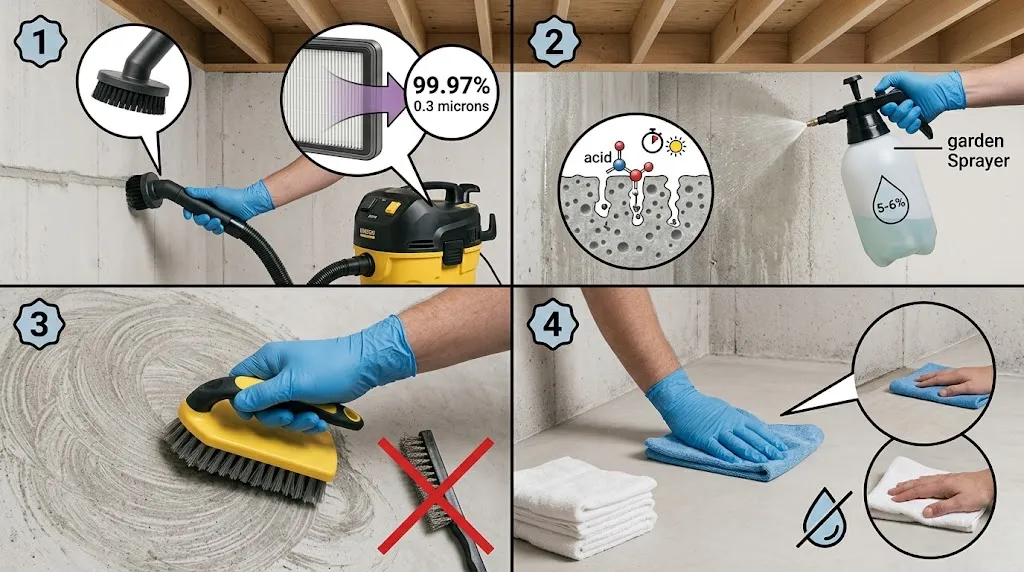
Begin your cleaning routine by vacuuming the dry concrete walls, subfloor joists, and foundation footings with a vacuum cleaner equipped with a certified HEPA filter. Never use a standard shop vacuum for this task. Regular shop vacuums utilize basic paper filters that trap coarse dust while blasting microscopic fungal spores straight out through the exhaust port, filling the basement with a hazardous airborne cloud. A sealed HEPA vacuum traps 99.97 percent of particles down to 0.3 microns, pulling loose dry spores out of masonry crevices without exhausting them back into the room. Slowly guide the vacuum brush attachment across the walls, focusing on mortar joints, floor cracks, and the cold joint where the slab meets the wall.
After vacuuming, fill a clean garden pump sprayer with undiluted distilled white vinegar containing five to six percent acetic acid, or use an EPA-registered botanical fungicide made with natural thymol oils. Spray the concrete until the surface appears wet, but avoid over-saturating the wall so liquid pools on the floor. Let the solution sit undisturbed on the surface for at least thirty to sixty minutes. This dwell time allows the natural acid to penetrate deep pores and destroy the fungal cell walls. Take a stiff-bristle nylon scrub brush and work the damp surface using firm, circular strokes to loosen fungal growth. Never use wire brushes, because steel bristles can pit the concrete and leave tiny iron fragments that turn into rust stains. Wipe away the dislodged residue using damp microfiber cloths. Rinse the section with a sponge dipped in clean, warm water, and dry the concrete immediately with clean cotton towels.
Identifying Ruined Materials: What to Bag and What Can Be Saved
Sorting through damp basement items requires tough decisions to stop fungal contamination from returning. Porous building materials and soft fabrics trap moisture and fungal spores deep inside their fibers, while solid surfaces can be cleaned and preserved.
- Cut away water-damaged drywall and wallboard twenty-four inches above the highest visible watermark using a utility knife, because moldy paper backing cannot be sanitized.
- Pull up moldy basement carpets, foam tack strips, and synthetic padding, roll them into small bundles, and wrap them tightly in plastic.
- Discard damp cardboard boxes, paper documents, old mattresses, upholstered furniture, and wet fiberglass insulation that show dark spots or smell musty.
- Preserve solid wood framing, structural beams, and sill plates by vacuuming the wood, sanding off light surface stains, and applying an antifungal borate wash.
- Save non-porous household items such as metal shelving units, hard plastic storage bins, glass containers, and ceramic pots by washing them with hot water and dish soap.
- Place all ruined materials inside heavy six-mil contractor trash bags right inside the basement, taping each bag shut before carrying it through the house.
Stopping Water at the Source: Exterior Drainage and Interior Moisture Control
You cannot keep a basement dry if rainwater pools against the outside foundation walls. Step outside during a heavy downpour and inspect the grade of the soil around your home. The ground should slope downward at least six inches over the first ten feet moving away from the foundation. If the soil slopes backward toward your siding, surface water flows against the masonry, creating extreme hydrostatic pressure that forces moisture through concrete pores. Clean your roof gutters twice every year to stop dirty water from cascading over the eaves, and attach sturdy downspout extensions that discharge roof water at least five to ten feet away from the basement perimeter.
Inside the basement, you need reliable mechanical equipment to handle natural groundwater and lower humidity levels. If water seeps along the joint between the floor slab and the foundation wall, install an interior perimeter drain pipe connected to a heavy-duty sump pump basin. Test your sump pump every spring by pouring a five-gallon bucket of water into the pit to make sure the float switch turns on smoothly. Install a high-capacity, low-temperature dehumidifier in the center of the basement. Standard residential dehumidifiers stop working when room temperatures fall below sixty-five degrees, whereas a basement-rated unit runs smoothly in cold air. Connect a garden hose to the dehumidifier drain port and route it directly into your sump pit or floor drain so the machine runs automatically, keeping the relative humidity locked below 50 percent all year long.
Managing High Basement Moisture Across California Microclimates
Basements face wildly different moisture challenges across the varied landscapes of California. In coastal areas like San Francisco, San Mateo, Santa Cruz, Santa Barbara, and San Diego, thick marine fog blankets neighborhoods for weeks, keeping outdoor air damp while winter atmospheric rivers dump inches of heavy rain that stress hillside foundations. Further inland across the Central Valley in Sacramento and Fresno, deep alluvial soils hold high groundwater tables near major river systems, while intense summer heat forces home air conditioning systems to run nonstop, causing cold basement ducts to sweat inside warm crawl spaces. In Southern California communities like Los Angeles, expansive adobe clay soils swell during rainy winters and shrink during hot summers. This continuous soil movement cracks underground concrete slabs, creating open paths for water to leak into the home.
Frequently Asked Questions About Basement Mold Removal
Can basement mold make you sick if you rarely go down there?
Yes, it can cause health problems. The stack effect naturally pulls 40 to 50 percent of ground-floor air straight up from the basement. As warm air rises through your house, it draws microscopic mold spores, musty odors, and fungal particles through subfloor gaps, electrical outlets, and heating ducts directly into your main living rooms and bedrooms.
Does painting over basement mold with waterproof paint kill it?
No, waterproof paint does not kill living mold colonies. Covering a moldy wall with paint merely hides the visible stains while moisture continues to wick through the concrete behind it. The growing fungus breaks down the paint’s bond, causing the new coating to bubble, crack, and flake off the wall within a few months.
How can I tell if my basement floor is damp under vinyl or laminate?
You can run a simple plastic sheet test on the bare concrete. Tape a two-foot square piece of clear plastic food wrap to the floor using heavy duct tape along all four edges, sealing the edges completely. Leave it in place for forty-eight hours. If water droplets collect on the underside of the plastic, moisture is rising through the concrete slab.
Does homeowners insurance cover basement mold removal?
Most standard homeowners insurance policies only cover mold remediation if the problem results from a sudden, accidental water disaster, such as a ruptured copper pipe or an overflowing water heater. Insurance policies almost always deny claims caused by gradual groundwater seepage, high indoor humidity, poor soil grading, or neglected home maintenance.
Complete Remediation Assurance: When to Bring in MoldOut California
Fixing a damp, contaminated basement can become overwhelming when the growth spreads across structural framing, behind finished drywall, or deep inside heating ductwork. Achieving complete clearance means that your basement smells completely fresh, wood framing moisture levels measure below 15 percent on a calibrated moisture meter, and laboratory air tests show spore levels matching clean outdoor air. Protect your home investment, improve your indoor air quality, and keep your family safe by scheduling a complete property assessment with the certified professionals at MoldOut California.
Don’t let hidden moisture, fungal growth, or musty smells damage your foundation and threaten your indoor air quality. Contact our experienced cleanup team today to book a professional basement inspection, locate moisture leaks, and make your home clean, dry, and safe once again.